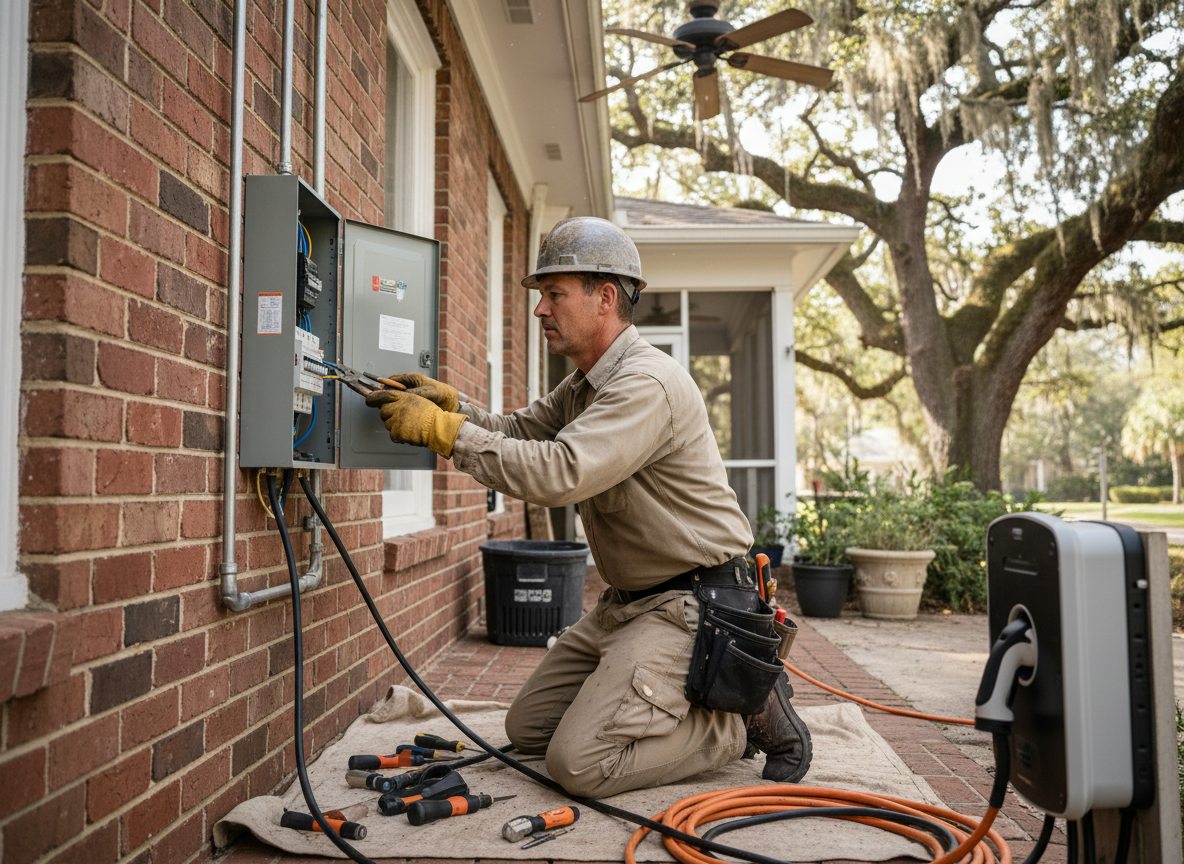
Montgomery's housing stock includes many pre-1970 homes in Capitol Heights and Highland Gardens with 100-amp panels and aluminum wiring that often require upgrades before adding a 240-volt EV charger circuit. Electricians must verify service capacity and run new conduit or cable from the panel to the garage or driveway, accounting for the clay-heavy soil that makes trenching more labor-intensive during the hot, humid summer months when afternoon storms can interrupt outdoor work.
Code compliance in Montgomery County follows Alabama amendments to the NEC, which require GFCI protection on outdoor receptacles and proper bonding for metal enclosures exposed to constant humidity. Installers also check for flood-prone spots near the Alabama River and Riverfront Park areas, where elevated mounting and weatherproof NEMA 4 enclosures prevent corrosion on Level 2 units. Homeowners in Eastdale and Dalraida frequently request integration with existing smart panels to avoid nuisance trips during peak summer loads.
Common edge cases include routing cable through finished basements in Old Cloverdale bungalows without disturbing plaster walls and confirming that Auburn or Birmingham commuters who park outside need longer runs with 6 AWG copper to maintain voltage drop limits. Technicians always leave the panel schedule updated and test the charger at full load before leaving the job.
Technician insight
In Montgomery, the thing that catches most people out with EV Charger Installation is the number of 1960s homes in Dalraida and Eastdale still running on 100-amp panels with original aluminum branch wiring. You cannot just add a 50-amp breaker without first confirming the service entrance can handle it, especially when summer humidity pushes AC loads higher.
Old Panel In Capitol Heights
Homeowner requested a Level 2 charger but the 100-amp panel was full and showed signs of overheating. We found undersized aluminum feeders from the 1970s. We replaced the service with a 200-amp panel, ran new 6 AWG copper to the garage, and installed the charger on a dedicated circuit. The system now handles full load without tripping even during peak summer afternoons.
EV Charger Installation Services We Offer
✓Residential Level 2 Charger Installation
Hardwired 240-volt circuit and charger mount for single-family homes in Montgomery neighborhoods, sized to the home's existing panel capacity.
✓Panel Upgrade for EV Charging
Replacement of 100-amp or 150-amp services with 200-amp panels to support dedicated EV circuits without overloading older wiring common in Capitol Heights.
✓Outdoor EV Charger Setup
Weatherproof conduit, elevated mounting, and NEMA 4 enclosure installation to handle Montgomery's humid summers and occasional heavy rain near the river.
✓Smart Charger Integration
Connection of Wi-Fi or app-controlled units to existing home automation systems while maintaining code-compliant disconnects and surge protection.
✓Commercial EV Charger Installation
Multi-unit charging stations for small businesses and offices serving employees commuting from Tuscaloosa or Auburn.
How it works
- 1
Site Assessment
Technician inspects the main panel, measures distances, and checks for aluminum wiring or prior upgrades in the specific Montgomery neighborhood.
- 2
Permit And Load Calculation
Submit load calculations to Montgomery County and confirm service capacity before any circuit work begins.
- 3
Circuit Installation
Run new conduit or cable from panel to charger location, install breaker, and mount the unit with proper grounding.
- 4
Testing And Handover
Full-load test the charger, update panel schedule, and walk the owner through app setup and safety features.
Pricing
Cost depends on panel condition, run length, and whether a service upgrade is needed.