2026-08-30 · Dale Whitfield
What a Nearby Lightning Strike Does to Your Wiring, Outlets and Appliances
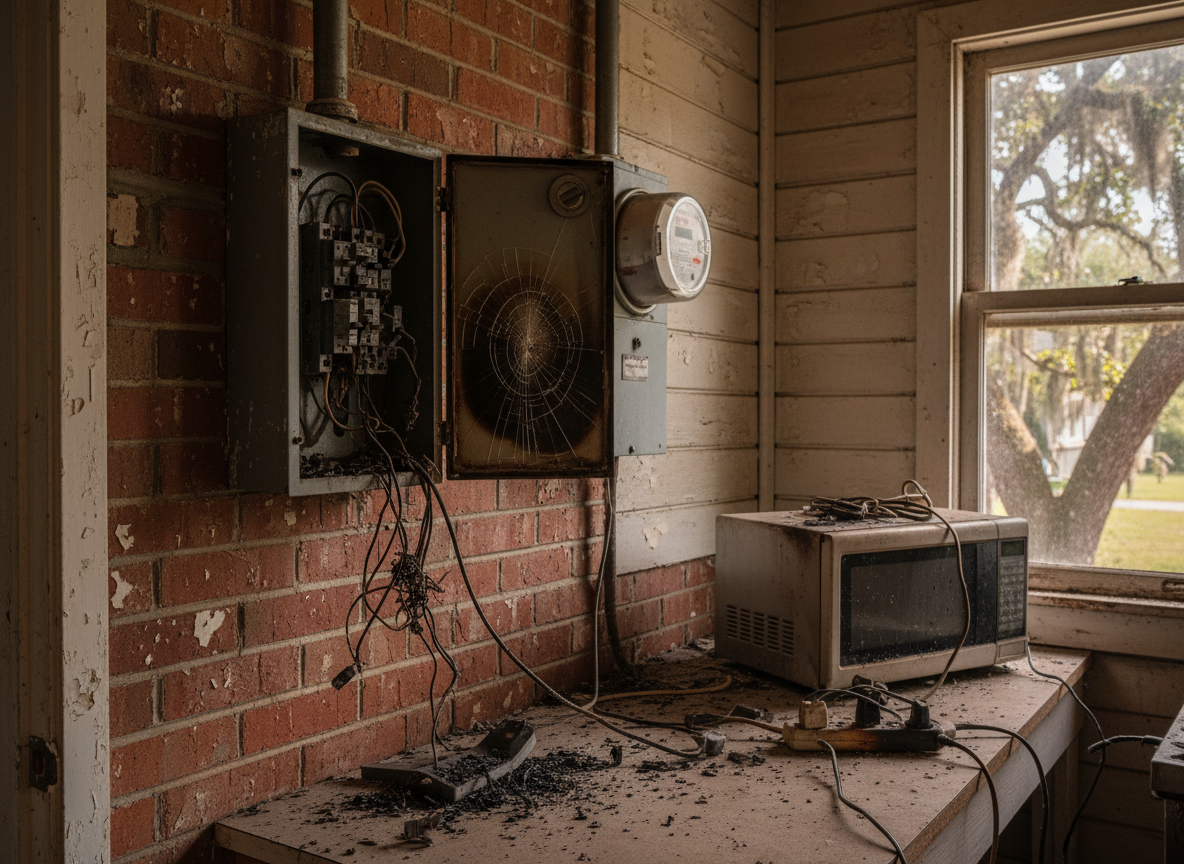
A nearby lightning strike induces a voltage surge on power, cable and phone lines that enters your home through the service and jumps to ground through your electronics. The damage pattern is scattered and partial: some devices die instantly, others are weakened and fail weeks later.
The mechanism: induction, not direct contact
A lightning channel carries tens of thousands of amps, and current that large creates an intense magnetic field. Any conductor within that field, the utility line down the street, your buried cable feed, the wiring in your walls, acts like the secondary of a transformer and has a voltage induced on it. That is why a strike a few hundred feet away, hitting a tree or the distribution line, still drives a surge into your house without touching it.
The surge arrives mainly on the service entrance conductors and secondarily on coax and phone lines, then propagates through the panel to every branch circuit. Voltage seeks the easiest path to ground, and in a modern home the easiest paths run through electronics: the switching power supplies, control boards and semiconductor junctions that connect line voltage to grounded chassis. A junction rated for a few hundred volts sees thousands for microseconds, and it either fails short immediately or is damaged and fails later. Devices connected to two systems at once, a TV on power and coax, an HVAC unit on power with a thermostat network, take the worst of it because the surge can pass through them between systems.
How to identify strike damage
The signature is scattered, partial failure across unrelated devices:
- GFCI outlets and AFCI breakers tripped or dead in different rooms
- The garage door opener, doorbell transformer or irrigation controller dead, the small always connected electronics go first
- HVAC not starting: control boards and contactors are the classic Alabama casualty
- Appliances with dead control panels but working motors
- Ethernet ports and cable modems dead while the rest of the device works
- A burnt electronics smell without a visible source
Wiring itself is usually spared, copper handles brief surges well, but the connections are not always. After a close strike, check for warm outlets or switch plates, breakers that will not reset, and any buzzing at the panel, because arc tracking at a weakened connection can smolder in the hours after a storm. That delayed window is why the fire department treats close strikes seriously even when nothing looks wrong.
What to do about it
Immediately after a close strike: walk the house with your nose and hands, smell for burning, feel plates for warmth, reset tripped GFCIs and note which will not reset. If anything smells hot or a breaker will not hold, shut that circuit off and get a lightning damage assessment that night, not next week. For insurance, photograph and list every failed device promptly; surge claims are common in Central Alabama, and carriers process documented lists faster.
For the future, protection is layered. A Type 2 surge protective device at the panel clamps the bulk energy arriving on the service. Point of use protectors at electronics catch the remainder that gets past it, and anything precious on both power and coax should have both paths protected. Grounding matters as much as the devices: an SPD is only as good as the grounding electrode system it dumps into, so verifying the ground rods and bonding during installation is part of the job, not an extra. And after any surge event, an SPD's indicator should be checked, because these devices sacrifice themselves and a spent SPD protects nothing while looking installed.
FAQ
My power flickered during a storm and now the AC will not start. Related?
Very likely. HVAC control boards, capacitors and contactors are the most common casualties of induced surges in this region. Have the HVAC diagnosed, and if the board is burnt, consider panel level surge protection before the replacement board meets the next storm.
Do plug in surge strips actually work?
Quality point of use protectors handle the residual energy that gets past a panel SPD, but alone against a close strike they are routinely overwhelmed. The layered approach, panel SPD plus point of use, is what the standards anticipate.
Should my wiring be inspected after a very close strike?
If the strike was close enough to damage devices, an inspection is cheap reassurance: panel connections, a sample of devices, GFCI and AFCI function, and the SPD's status. Direct hits to the house or a tree touching the service warrant it without question.